Fiddle Leaf Fig Care: Why It’s Fussy and How to Keep It Happy
If houseplants had reputations the way people do, the fiddle leaf fig would be the gorgeous friend who cancels plans at the last minute for reasons nobody quite understands. Its big, violin-shaped leaves and sculptural trunk have made it the plant world’s favorite piece of living furniture, but ask anyone who has owned one for more than a few months and you’ll hear the same story: a happy plant one week, a plant dropping leaves in a panic the next. The good news is that fiddle leaf figs (Ficus lyrata) aren’t actually mysterious. They’re just specific. Once you understand what they want, keeping one thriving gets a lot less nerve-wracking.
Why Fiddle Leaf Figs Have a Reputation for Being Difficult
Fiddle leaf figs grow as understory trees in the tropical rainforests of western Africa, where they get bright, filtered light, consistent warmth, and steady humidity without ever really drying out or sitting in soggy soil. Most homes cannot replicate that environment perfectly, and fiddle leaf figs are quick to let you know when conditions drift too far from what they expect. They also dislike change in general — a new spot, a draft, a shift in the seasons — and will often respond to any disruption with the same move: dropping leaves. This makes them feel fussy, but really they’re just sensitive and consistent. Give them consistency back, and they settle down.
Light: The Number One Factor
Most fiddle leaf fig problems trace back to light. These plants need bright, indirect light, and a lot of it — more than a philodendron or pothos would tolerate. A spot a few feet from a large south- or east-facing window, where the plant gets bright light for most of the day without hours of direct scorching sun, is ideal. Too little light shows up as small new leaves, leggy growth reaching toward the window, and a plant that just seems to sulk. If your fiddle leaf fig is in a dim corner because it looks striking there, it will eventually tell you so with dropped leaves.
Once you find a good spot, resist the urge to move the plant around. Fiddle leaf figs orient their leaves toward a consistent light source, and relocating them forces them to readjust, which often triggers leaf drop. If you need to rotate the pot for even growth, do it gradually — a quarter turn every week or two rather than a dramatic reposition.
Watering: Consistency Beats Perfection
Fiddle leaf figs want evenly moist soil, not wet and not bone dry. The easiest way to get this wrong is to water on a fixed schedule instead of checking the plant. Instead, stick your finger two inches into the soil; when it feels dry at that depth, it’s time to water thoroughly until liquid runs from the drainage holes, then let the pot drain completely. Never let the plant sit in a saucer of standing water, since that’s one of the fastest routes to root rot.
Both underwatering and overwatering tend to show up the same way at first — drooping and leaf drop — which is exactly why fiddle leaf figs get blamed for being impossible to read. The difference usually shows in the details:
- Underwatered leaves often look dry, curled, or crispy at the edges, and the soil pulls away from the pot’s sides.
- Overwatered leaves tend to develop brown spots with a yellow halo, feel soft, and the soil stays soggy for days after watering.
A pot with good drainage holes and a well-draining potting mix makes it much easier to avoid overwatering, which is the more common — and more dangerous — mistake with this species.
Humidity and Temperature
Fiddle leaf figs appreciate humidity in the 40 to 60 percent range, which is higher than the average home, especially in winter when heating systems dry out the air. You don’t need a rainforest in your living room, but running a small humidifier nearby, grouping plants together, or setting the pot on a tray of pebbles and water can help. Just as important is avoiding temperature swings: keep your fiddle leaf fig away from cold drafts near doors and windows, heating vents, and air conditioning units. A steady room temperature between 65 and 75°F is the sweet spot, and sudden cold snaps are a classic trigger for leaf drop.
Soil and Repotting
Use a well-draining potting mix, ideally one formulated for indoor trees or a standard houseplant mix amended with perlite or orchid bark for extra drainage. Fiddle leaf figs like their roots slightly snug, so there’s no need to rush into a bigger pot. As a general rule, repot every one to two years, or when you see roots circling the drainage holes or emerging from the top of the soil. When you do repot, go up only one pot size — jumping to a much larger container leaves excess soil that stays wet too long and invites root rot.
Feeding Your Fiddle Leaf Fig
During the active growing months of spring and summer, a balanced liquid houseplant fertilizer diluted to about half strength, applied every four to six weeks, supports steady new growth. Ease off in fall and skip fertilizing entirely in winter, when the plant’s growth naturally slows and it needs less to work with. Feeding a dormant or slow-growing plant heavily can build up salts in the soil and stress the roots rather than help.
Common Warning Signs and What They Mean
- Brown spots with yellow halos: usually a bacterial or fungal issue linked to overwatering or leaves getting wet and staying damp.
- Dropping lower leaves one at a time: often just normal aging, especially if the rest of the plant looks healthy and new growth is emerging.
- Sudden mass leaf drop: almost always a stress response to a big change — a move, a cold draft, a repotting shock, or a dramatic shift in watering.
- Small, sparse new leaves: a sign the plant isn’t getting enough light or nutrients to support full-sized growth.
Cleaning and Dusting the Leaves
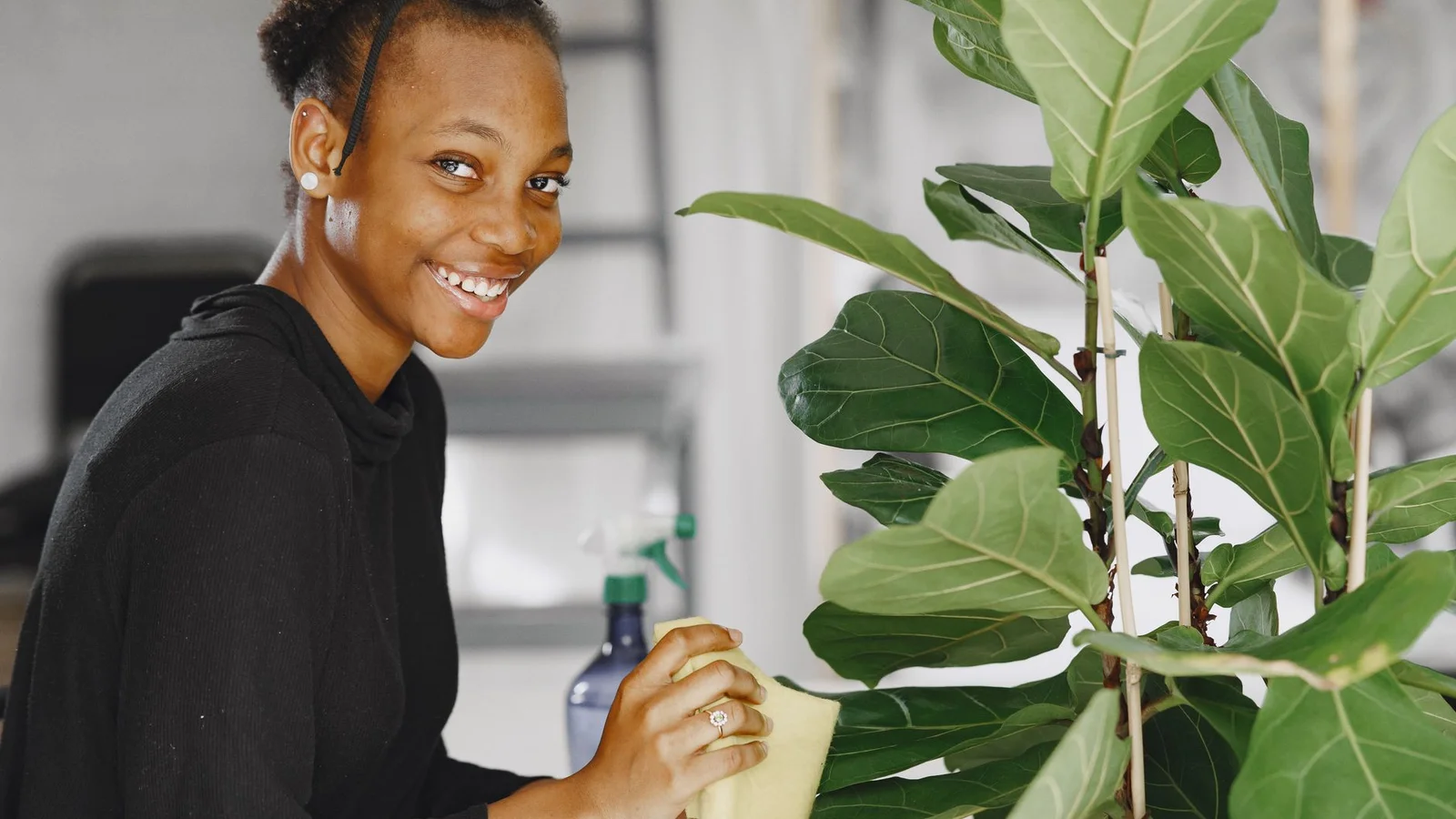
Those broad, glossy leaves collect dust quickly, and a dusty leaf can’t photosynthesize as efficiently as a clean one. Wipe leaves gently every few weeks with a soft, damp cloth, supporting each leaf from underneath so you don’t tear it. This is also a good moment to check the undersides for early signs of pests like spider mites, which favor the same warm, somewhat dry conditions that stress out fiddle leaf figs in general.
Setting Realistic Expectations
Even with excellent care, it’s normal for a fiddle leaf fig to drop a leaf here and there, especially older lower leaves as the plant grows taller and puts its energy into new growth up top. The goal isn’t a plant that never loses a single leaf — it’s a plant that keeps producing new leaves faster than it drops old ones, with foliage that stays a rich, even green rather than developing widespread brown spots or curling.
Fiddle leaf figs reward patience and routine far more than they punish small mistakes. Once you’ve found the right spot, settled into a watering rhythm based on the soil rather than the calendar, and committed to leaving the plant where it is, you’ll likely find that the drama calms down considerably. It’s not that your fiddle leaf fig is impossible to please — it just wants you to notice what it’s telling you, and to keep showing up the same way, day after day.